
AI Website Builder
AI website builders are free to build, paid to publish. Here's what nine builders actually charge for domains, payments, and bookings — and how to pick.
Start for Free
In short
An AI website builder generates a complete website — structure, copy, and design — from a short description of your business, usually in under ten minutes. Most are free to build and paid to publish, and native booking support now varies more by platform than by category.
Key takeaways
- Nearly every AI website builder is free to build and paid to publish — connecting a domain, removing branding, or accepting payments all require a paid plan.
- Paid tiers range widely: from ~$4/mo (WordPress.com Personal) to $49/mo (OhhWells Growing), and intro pricing often jumps sharply at renewal.
- Several mainstream builders now offer native booking as one feature among many; others default to a "Book Now" button linking to a separate tool.
- AI-generated copy is a bigger SEO risk than the platform itself — all major builders produce indexable sites, but generic copy doesn't rank.
- No builder has an inherent SEO or booking advantage by category alone — the differences are platform-specific, not AI-vs-traditional.
What is an AI website builder?
An AI website builder is a tool that uses generative AI to create a website's structure, copy, and design from a text prompt, rather than requiring you to choose a template and fill it in manually.
The category splits into three types, and the distinction matters more than the marketing suggests:
Most small business owners want the first type and end up frustrated by the third.
Are AI website builders actually free?
No. Nearly every AI website builder is free to build and paid to publish. You can generate a site, see it, and edit it without paying. Connecting your own domain, removing the tool's branding, and accepting payments all require a paid plan.
That is the industry norm, not a scam — but it is rarely stated before you've spent two hours on a site.
Here is what each actually costs at the point it becomes a real business website:
Prices are for the lowest plan that permits a custom domain on an ad-free site. Checked (28 July 2026). Vendors change these frequently — if you spot an error, tell us and we'll correct it.
The three costs people miss:
- The domain is separate. Almost always billed on top, and almost always free for year one only.
- Booking and payments usually sit behind a higher tier than the one you'd pick based on the pricing page's headline number.
- Annual billing is what's advertised. The monthly price is typically meaningfully higher.
Which AI website builder is best?
There is no single best one, because they optimise for different things. The right question is which constraint you care about most: speed to launch, design control, cost at scale, or whether the site can actually run your business.
Read that table honestly. If you need a site live this afternoon and don't care how it looks, Durable or Hostinger will beat us. If you are a designer, use Framer. We are the right answer for one specific person: a service business owner who takes bookings and refuses to look like a template.
Can an AI website builder handle bookings?
Mostly no — and this is where the category quietly fails small service businesses. AI website builders are optimised to produce a beautiful homepage. A booking system is not a page; it's software with availability, timezones, deposits, cancellations, and reminders. Generating one from a prompt is a different problem, and most builders don't try.
What usually happens instead:
- The AI generates a "Book Now" button that scrolls to a contact form.
- You bolt on a third-party booking tool, which looks nothing like your site.
- The booking flow breaks on mobile, where most of your customers are.
- You now maintain two systems and reconcile them by hand.
For a yoga studio, a salon, or a clinic, the booking flow is the website. Everything else is decoration.
What to check before you commit to any builder:
- Can a customer book without leaving your site?
- Does the booking page inherit your fonts and colours, or the vendor's?
- Can you take a deposit?
- Does it work on a phone in one thumb?
- If you hire someone to build it, can they hand ownership to you cleanly?
That last question catches almost everyone.
Are AI website builders any good?
Yes, at layout and speed. No, at brand and business logic. This is a fair summary of the current state of the category, and pretending otherwise would be dishonest.
What they genuinely do well:
- Produce a competent, responsive layout in minutes
- Write serviceable first-draft copy
- Remove the blank-page problem entirely
- Cost far less than an agency
Where they consistently fall short:
- Sameness. Trained on similar data, producing similar sites. Your competitor's site was generated by the same tool from a similar prompt.
- Brand. The AI doesn't know why your studio feels different, so it can't express it.
- Bookings and payments. See above.
- SEO depth. Generated copy is generic, and generic copy doesn't rank.
The useful mental model: an AI website builder is a very fast intern with excellent taste in layouts and no knowledge of your business.
How do you build a website with AI?
The process is roughly the same across every tool:
- Describe your business in a sentence or two — what you do, who for, and the feeling you want.
- Let it generate. Take the layout, distrust the copy.
- Replace every word. The generated copy is a placeholder that reads like real copy. This is the step everyone skips and everyone regrets.
- Add your real photos. Stock imagery is the single fastest way to look like a template.
- Connect your domain — this is where you'll be asked to pay.
- Set up bookings and test the entire flow on your own phone.
- Check speed and mobile before launch.Steps 3 and 6 are where AI-built sites are won or lost.
Which AI website builder is best for SEO?
None of them, out of the box. SEO is decided by your content, your page speed, and your site structure — not by which tool generated the HTML. All the major builders produce technically adequate, indexable sites.
The real SEO risk with AI builders is the generated copy: it's generic by construction, and generic pages don't rank against pages written by someone who knows the subject. Rewrite it.
Do you still need a designer?
For most small businesses: not for the build — but often for the direction.
An AI builder eliminates the mechanical work of assembling a website. It does not decide what your brand feels like, what you're actually selling, or which single action every page should drive. That's strategy, and it's the part that determines whether the site earns its cost.
If you don't want to make those decisions yourself, you have two options: hire someone, or use a builder that makes them for you.
Already have a site? Find out if it's costing you bookings.
The free OhhWells audit checks your site across 6 dimensions and returns a Conversion Score in under two minutes. No signup needed.
Run the free audit →Frequently asked questions

Keep reading
OhhWells vs. The Field: Agency Website Platform Price & Value Comparison
How OhhWells compares on price and value against GoHighLevel, Webflow, WordPress, Wix Studio, and Brizy — one table, every platform.
Lovable vs Bolt: Which AI App Builder Should You Actually Use?
Lovable vs Bolt, compared honestly: how their pricing actually differs, where each wins, and the team-pricing gap most comparisons miss.
Best AI for Website Design (2026): An Honest Guide for Small Business Owners
A plain-English comparison of the best AI website design tools in 2026 — what each is good at, and why looking good isn't the same as converting.
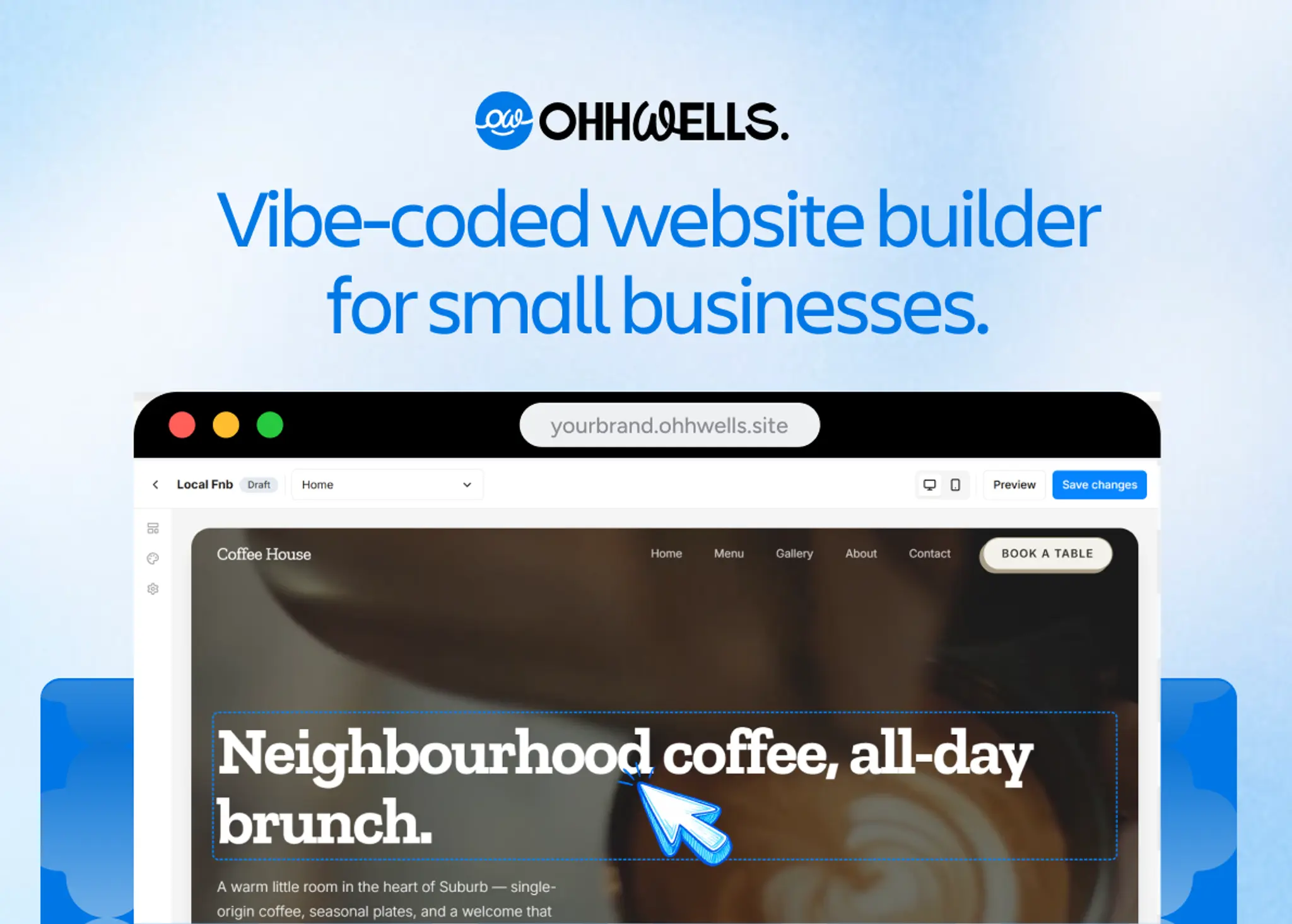
AI Website Builder for Small Business: An Honest Guide (2026)
AI can build your small business site in minutes — but it'll look like everyone else's. Here's how to pick the right builder and fix what breaks after launch.
Best Free Website Audit Tools for Small Businesses
9 free tools, one big blind spot. Here's what each one checks — and the one thing none of them tell you.