In short
Framer makes some of the most beautiful websites on the internet. It's also a designer's tool, priced for design teams — and it can't take a booking. OhhWells is just as design-led, built for the person running the business rather than the person designing it, with native bookings and a Conversion Score that checks 30 things before you publish.
If you're looking for a Framer alternative, you've probably hit one of these
Framer people usually arrive here for one of these reasons — and they're all the same reason wearing different clothes:
- You bought a gorgeous template, and now you can't confidently change it. The canvas assumes you think like a designer: breakpoints, layers, stacks, constraints. You just want to move the button.
- Your site is genuinely beautiful and the enquiries aren't coming, and you have no idea which of those two facts to blame.
- You wanted to take bookings. Framer doesn't do bookings. You're embedding Calendly and paying for that too.
- The bill didn't match the pricing page. $10 became $30 for a CMS and forms, then $20 a month for each person who edits — so letting your studio manager update a class time costs another seat.
- You tried to just use the free plan, and found it can't connect your domain and — you're stuck on a Framer subdomain with 1 GB of bandwidth. It's a demo, not a plan.
- You hired a designer to build it, and now you need them every time you want to change a price.
You care about how your business looks. That was never the problem. The problem is that Framer is a tool for making beautiful things, and you needed a tool for running a business.
The problem isn't the design. It's that Framer is built for designers, and you're not one.
Framer earned every bit of its reputation. It came out of the design-tool world and it shows: the output is stunning, the animation is best-in-class, and for a design team shipping marketing campaigns it's a joy. That heritage is exactly the catch. Framer's mental model is a designer's mental model — and if you don't already have it, "no-code" doesn't mean "no learning." It means the code is gone and the design thinking is still very much required.
Then look at how it's priced, because pricing tells you who a product is for. Site plans and editor seats are billed separately. Every full editor on your site costs about US$20 a month on top (a content-only editor is US$10). That's a completely sensible model for an agency with five designers and forty clients. For a studio owner who wants her front-desk manager to be able to fix a typo, it's a tax on the most ordinary thing in the world.
And here's the part that matters most for you: Framer will build you something beautiful and tell you nothing about whether it works — before you publish, at least. There's no pre-publish check on whether your page is set up to convert. The closest thing Framer offers is A/B testing, sold as a paid add-on on top of Pro or above — and even then, it can only tell you which of two live pages is winning, once your site is already published and has real visitors to run the test on. It measures. It doesn't advise. If you haven't published yet, or don't have much traffic, it has nothing to tell you.
OhhWells starts from the other end. The templates are just as considered — but structured the way high-converting service sites are structured, and the editor is designed so you can't break them, because you shouldn't need a designer's instincts to move a button. Booking management is native. And before you publish — with zero traffic, zero cost — the Conversion Score checks your site against 32 factors across 8 dimensions and tells you, plainly, what to fix. Same beauty. Plus the part that pays your bills.
See your Conversion Score
Check for free →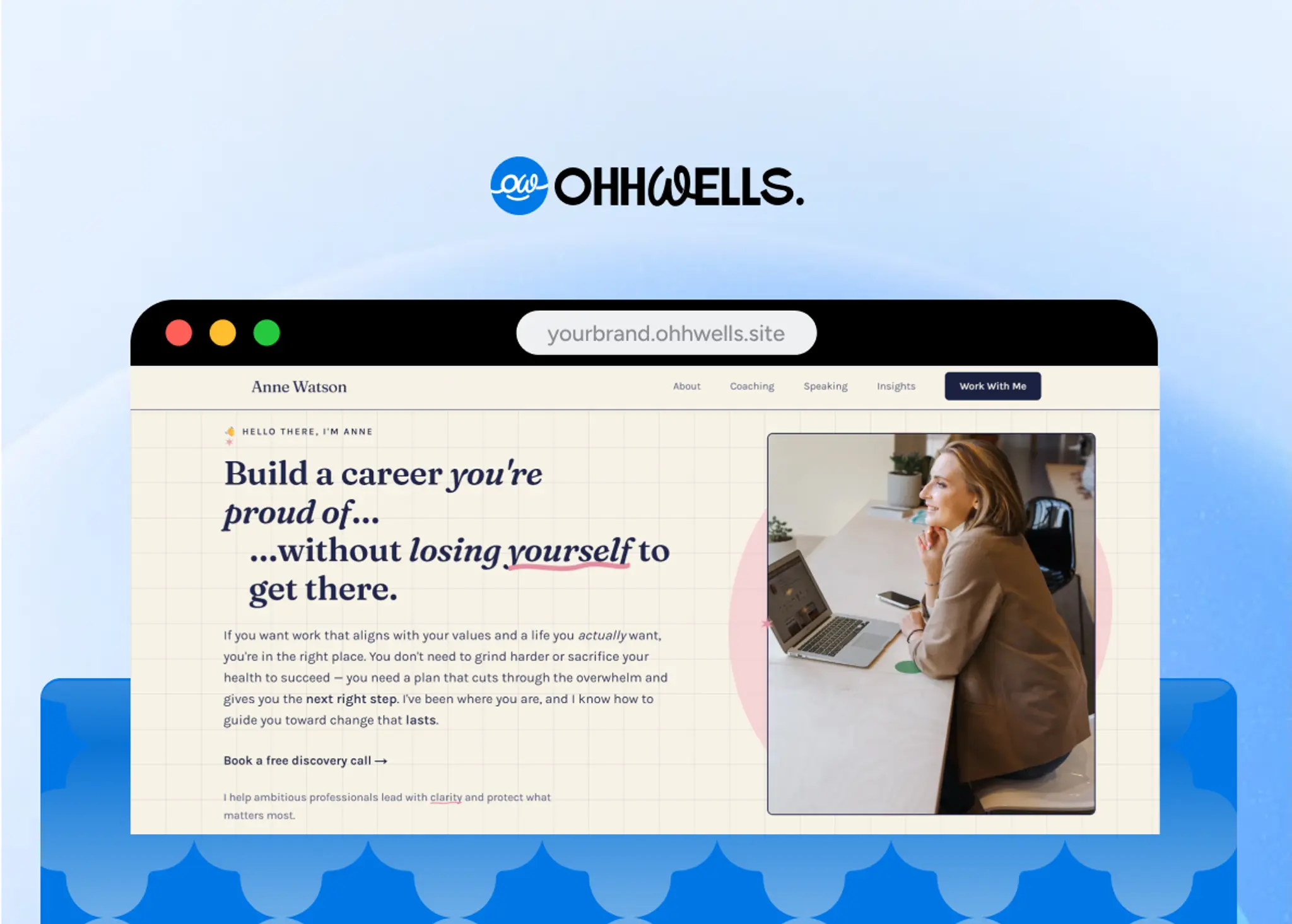
OhhWells vs Framer, at a glance
Where each one really pulls ahead
Framer is an excellent product. A fair comparison says where it wins, and it wins in real places.
Pure design and craft. Give a good designer Framer and they will out-build almost anything, including us. The animation, the interactions, the sheer finish of the output — it's the best in the category and we're not going to pretend otherwise. What we'd say is this: that ceiling is only reachable if you have the hands to reach it. Most small business owners are buying a template and hoping not to break it. OhhWells templates are designed to be beautiful at the floor, without a designer, on the first afternoon. Framer's ceiling is higher. Our floor is much, much higher.
See OhhWells templates
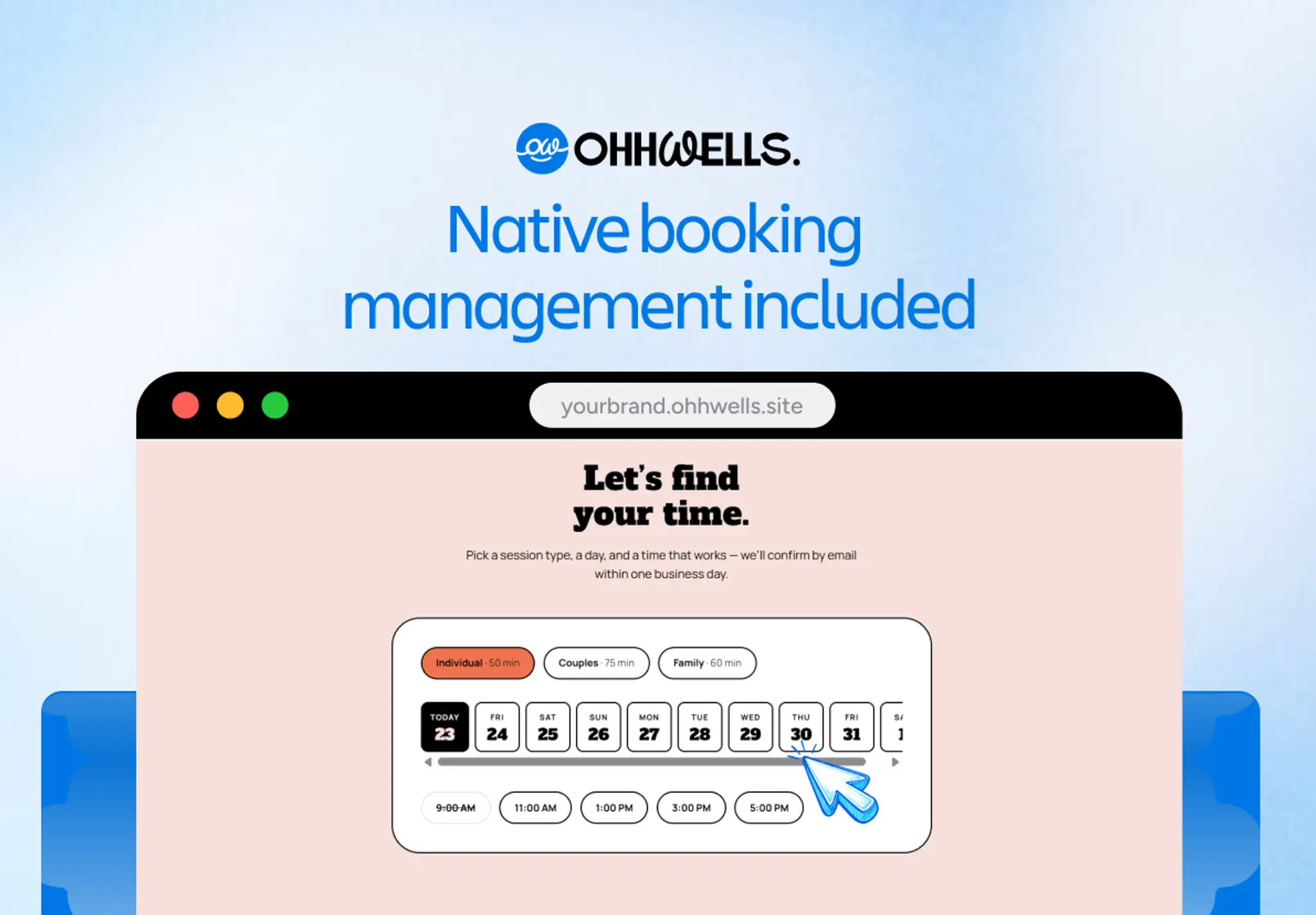
Try for freeGetting booked. This is the plain one. Framer has no booking system. For a studio, a clinic, a salon — the businesses whose entire revenue arrives through a calendar — that's not a gap in a feature table, that's the product not doing the job. You'd embed Calendly on top: another tool, another login, another bill, and a booking flow that never quite feels like your site. OhhWells includes native booking management on every plan.
Knowing if it works. Framer makes beautiful things. It won't tell you whether the beautiful thing is bringing anyone in — anot before you publish, at least. If you want to test that, A/B testing sits behind a paid add-on on Pro or above, and it can only compare two live variants once your site already has real traffic to measure. It's a genuinely good tool for optimising a page that's already working. It's no help at all for the question that matters most before launch: is this page set up to convert in the first place? The Conversion Score answers exactly that, for free, before you publish, in plain language. You can already see whether your site is beautiful. This is the bit you can't see — and Framer only helps you see it after you've paid, published, and waited for traffic.
Letting your team touch it. Framer charges roughly US$20 a month for every full editor seat, on any paid plan (a cheaper US$10/mo content-only seat covers CMS and copy edits). Think about what that means day-to-day: your manager updating a class time is a line item. With OhhWells, the people who work in your business can edit your website. That's not a feature, it's just how it should be.
The free plan. Both of us have one; they're not the same object. Framer's is built for testing and personal projects — a Framer subdomain, capped bandwidth, no custom domain. OhhWells' free plan is a real published site on a subdomain, with the full editor and the Conversion Score, that you can genuinely run a business on for as long as you want. You pay when you want your own domain.
The real monthly cost. Framer's $10 Basic plan is built for personal sites and freelancers; a small business will generally need Pro for real CMS capacity, staging and redirects. From there, the bill climbs with each extra: a seat for your manager, A/B testing if you want it, Calendly for bookings since Framer has none. None of these are optional for a working business site — they're just billed separately. OhhWells includes bookings and the Conversion Score on every tier, and everyone on your team can edit at no extra cost.
Where Framer is the better call. If you're a designer, or you employ one, take Framer — you'll build something we can't match and you'll enjoy doing it. Same if you're a startup or agency shipping marketing campaigns with a design team behind them, or if what you need is a portfolio to show off craft rather than a site to take bookings. OhhWells is for the owner who has no designer, no plans to hire one, and a diary to fill.
Switching from Framer is simpler than you think
The dread is usually two things: losing a site you think is beautiful, and the hassle of moving. Both are smaller than they look.
We don't do an automated import — there's no "click to migrate" software. What we do is manual: you send us your current Framer URL, and our team rebuilds it under OhhWells — your content, copy, and images carried across, with the layout restructured around what actually converts. Your bookings come in-house too, off Calendly, so you're consolidating tools rather than juggling them. Your existing domain connects in a few minutes on a paid plan. And because the editor is built so you can't break the design, you don't need a designer once it's handed over — most switchers manage day-to-day edits on their own from there.
And you're not trading down on looks to do it. That's the thing worth saying twice: OhhWells is design-led too, by people who care about this as much as you do. The point isn't a plainer site — it's an equally beautiful one that also takes bookings and tells you when it isn't working.
Build your site free
Try OhhWells →What you actually pay each month
Framer prices in two parts, and this is where budgets break: site plans and editor seats, billed separately. The headline number only covers the site.
(On the live page this is a monthly/annual toggle, defaulted to annual.)
Then add what Framer bills separately: ~US$20/mo per full editor seat (or US$10/mo for content-only editing), US$20/mo per additional locale, A/B testing as a paid add-on on Pro or above, and Calendly or similar for bookings, since Framer has none. With OhhWells, bookings and the Conversion Score are on every tier, your whole team can edit at no extra cost, and you can publish free before you pay a cent.
"But what about…"
I don't want a less beautiful website. You won't get one. This isn't "pretty vs practical" — OhhWells is built by people who care about design as much as Framer's users do. Build a site free and judge the look yourself before you decide anything.
I paid a designer to build my Framer site. Then the honest question isn't whether it's beautiful — it is — but whether you can run it without them. If every price change is an email and an invoice, that's the cost you're actually comparing, not $30 a month.
Will I lose my Google ranking? Your content and structure carry over, and standard redirects keep your existing pages pointing to the right place. Rankings always shift a little around any move — the aim is a clean transition onto a site that's better set up to convert.
I already have Calendly wired into my Framer site. Then switching is a simplification: bookings move in-house, so it's one fewer tool and one fewer bill, not another thing to connect.
Isn't Framer's free plan the same as yours? Not really. Framer's can'tconnect your own domain — you're on a Framer subdomain with limited bandwidth, and it's built for testing and personal projects. Ours is a site you can publish and live on, indefinitely, with bookings and the Conversion Score working. You pay when you want your own domain.
Doesn't Framer already have something like the Conversion Score? Not before you publish. Framer's A/B testing (Convert) is a paid add-on on Pro or above, and it only works once your site is live with real traffic — it tells you which of two published variants is winning, not what to fix before launch. The Conversion Score runs before you publish, for free, on every plan.
What if I outgrow it? OhhWells is built for service and booking businesses that want beauty and bookings in one place. If you're heading somewhere that needs a design team and a design tool, we'll tell you honestly — that's Framer, and it's a good answer.
OhhWells is built for you if you…
- Run a service or booking-based small business — a studio, a practice, a salon, coaching
- Want a beautiful, on-brand site without being a designer or hiring one
- Take bookings, and are tired of paying for the site and the scheduler separately
- Want your team to be able to edit your website without buying them a seat
Stick with Framer if you…
- Are a designer, or have one — the ceiling really is higher there
- Need best-in-class animation and interaction craft above all else
- Are building a portfolio to show off work rather than a site to take bookings
- Run a design team shipping marketing campaigns, where per-seat pricing makes sense
Beautiful is the start. Booked is the goal.
Build your site free, publish it on an OhhWells subdomain, and check your Conversion Score — all before paying anything. No designer required, no seat fees, no separate scheduler to buy.
Compare all plans
Build your site free →